OpenAI says GPT-6 models design proteins with reasoning and code, and some bind their targets in lab tests
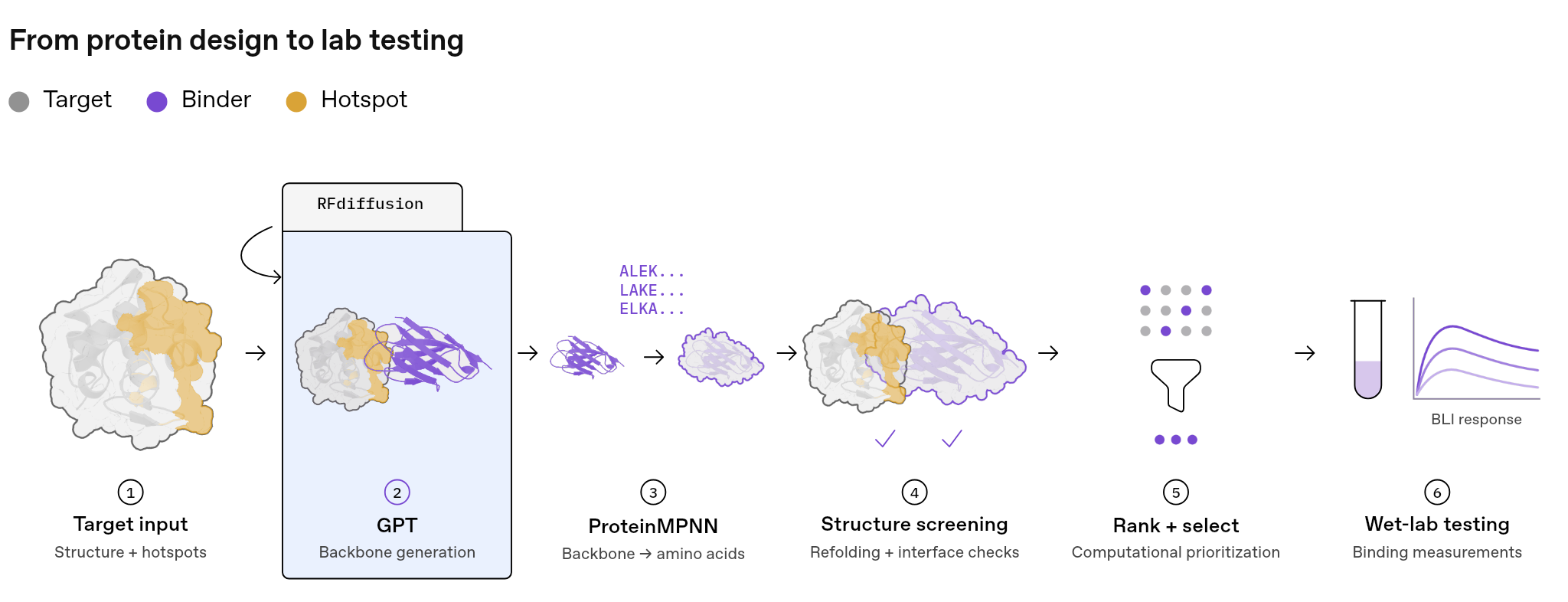
In a preprint, OpenAI reports 35 of 322 minibinders built from GPT-6.2 designs (10.9%) showed binding across five targets; specialized models still supplied sequences and picked candidates.
Why it matters
Protein design has relied on specialized tools such as RFdiffusion and ProteinMPNN. OpenAI says a general model can now do several of those jobs from plain-language instructions, performing comparably to or better than specialized models on most of 14 computational tasks. The lab evidence is early: binding was the only measure, the 10.9% hit rate is below the original RFdiffusion study, and full structure prediction remained a clear weakness. Watch for independent replication and tests of specificity and function.
Key facts
- 35 of 322 minibinders (10.9%) bound their targets
- At least one hit for each of five targets, including PD-L1 and IL-17A
- Designs from a pre-release GPT-6.2; SolubleMPNN supplied sequences
- Lab partner: Onava
- Redesigned MDM2 minibinders bound in 75 of 88 designs (85%)
- Full structure prediction remained a weakness