Ex-OpenAI researcher finds Blackwell fingerprints in six Chinese AI models from DeepSeek, Moonshot, MiniMax and Ant
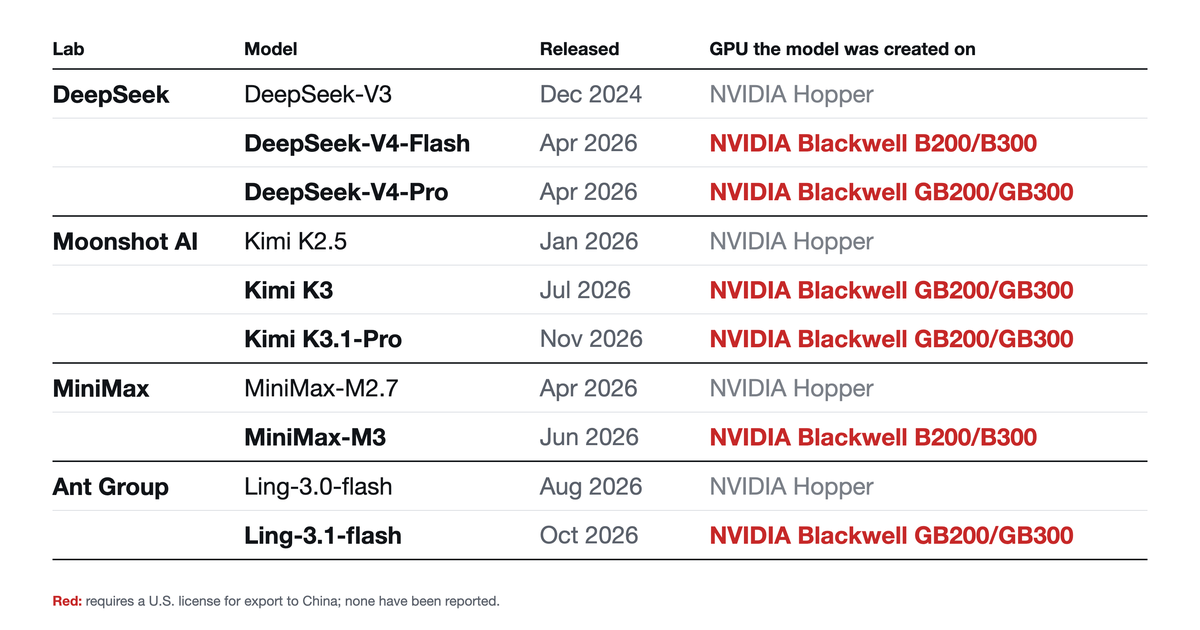
Will DePue's Unemployment Labs analysis matches initialization patterns in models released since April to Nvidia's export-barred Blackwell chips; it identifies the hardware that set the starting weights, and whether those chips also did the training is an inference.
Why it matters
If it holds up, this is the first published technical evidence that leading Chinese labs built recent models on Blackwell chips barred from export to China; U.S. officials and press reports had alleged DeepSeek and Moonshot used Blackwell without showing proof. It lands as Congress weighs new chip-export bills after the Jensen Huang scandal. The method reads hardware layout from published weights alone, and the newest models from Alibaba, Zhipu, Tencent, Xiaomi and StepFun still read as Hopper. Watch for independent replication, responses from the four companies and whether Commerce or Congress cites it.
Key facts
- Six open-weight models from DeepSeek, Moonshot AI, MiniMax and Ant Group match Blackwell
- DeepSeek-V4-Flash and MiniMax-M3 read as B200 or B300
- DeepSeek-V4-Pro, Kimi K3, Kimi K3.1-Pro and Ling-3.1-flash read as GB200 or GB300
- Earlier DeepSeek-V3, Kimi K2.5, MiniMax-M2.7 and Ling-3.0-flash read as Hopper
- Newest readable Alibaba, Zhipu, Tencent, Xiaomi and StepFun models read as Hopper
- Hopper has 132 SMs, B200/B300 148 and GB200/GB300 152