METR says OpenAI's pretraining loss has fallen about seven times faster since early 2026
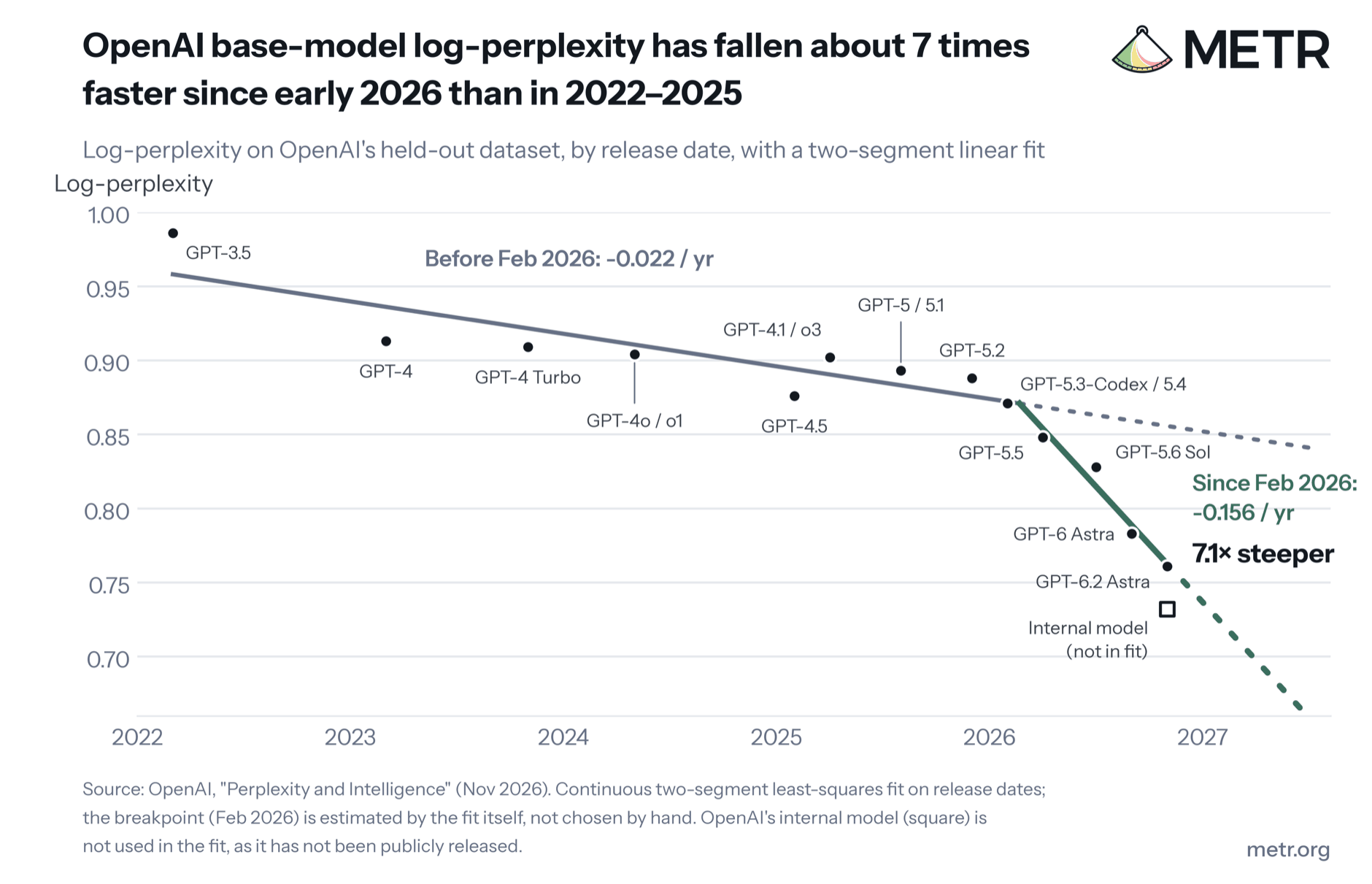
METR analyses OpenAI's published log-perplexity for 13 models since GPT-3.5; its staff have no consensus on what the jump means for real-world capabilities.
Why it matters
No frontier developer had previously published multi-year pretraining loss on a fixed held-out set, METR says, and it urges others to do the same, as Microsoft has since done using OpenAI's dataset. If the pace holds, OpenAI would match the GPT-3.5 to GPT-4.1 drop, which took three years, in about six and a half months. METR notes the acceleration is not matched by OpenAI's benchmark scores, such as Epoch's ECI. Watch whether other labs publish loss curves and whether capability measures start to bend.
Key facts
- 13 OpenAI models since GPT-3.5
- Loss falling about 7x faster since early 2026 than in 2022–2025
- GPT-3.5 to GPT-4.1 drop took three years; about 6.5 months at current pace
- No comparable acceleration in benchmark scores such as Epoch's ECI
- Microsoft has shared results on OpenAI's dataset
- Authors: Ajeya Cotra, Jean-Stanislas Denain, Tom Cunningham