METR finds frontier AI time horizons doubling about every 3.6 months on a harder task suite
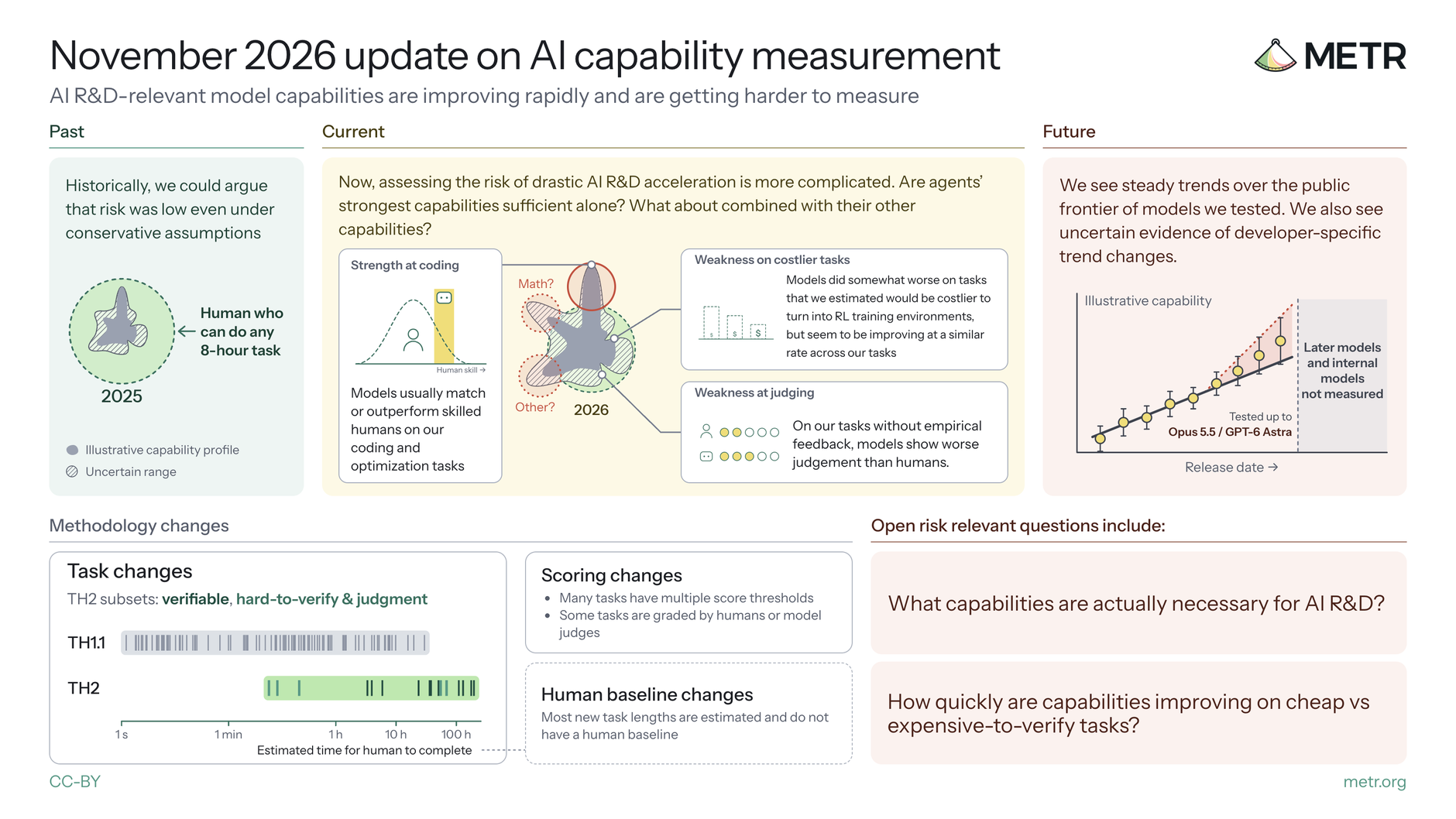
Its Q4 capability update, covering models up to Opus 5.5 and GPT-6 Astra, says agents match or beat skilled humans on coding and optimisation but show worse judgment than experts where feedback is unclear, and that public evidence cannot rule out drastic AI R&D acceleration in the next couple of years.
Why it matters
METR's time-horizon chart is one of the most cited measures of AI progress; this update adds a harder suite, TH2, with fuzzier, judgment-heavy tasks closer to AI research work. MIT Technology Review notes that none of the evaluations models designed for METR were judged useful by its staff. The doubling time on the combined suite is similar to a trend OpenAI reported on internal research tasks. METR says capabilities are getting harder to measure, which matters for risk arguments that relied on clear limits.
Key facts
- Covers public models up to Opus 5.5 and GPT-6 Astra
- Combined TH1.1 and TH2 doubling time: about 3.6 months
- Models usually match or beat skilled humans on coding and optimisation tasks
- Agents show worse judgment than experts without clear feedback
- Published 20 November 2026