USTC team publishes structRFM, an open RNA foundation model trained on 21 million sequence-structure pairs
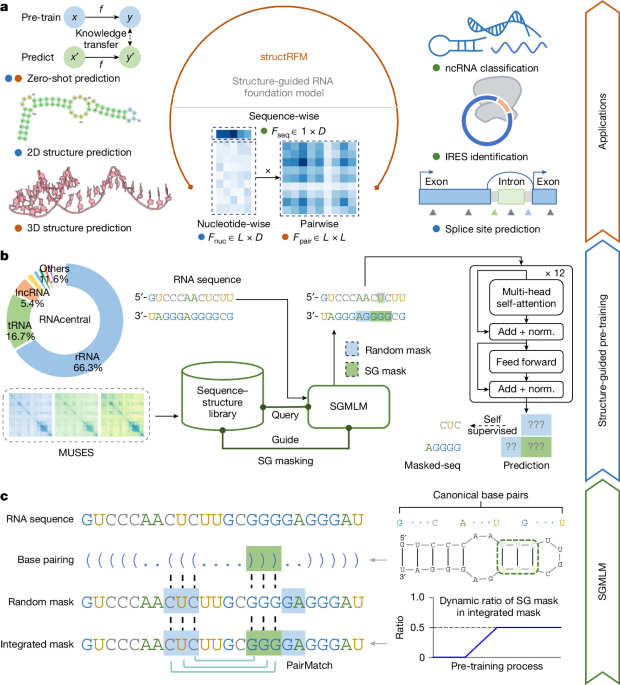
The Nature paper says its 3D adaptation, Zfold, performs comparably to AlphaFold3 on CASP15, CASP16 and RNA-Puzzles; the full dataset, weights and code are open.
Why it matters
Most RNA language models learn from sequence alone, but RNA function depends on how the molecule folds. structRFM builds base-pairing into pre-training, using a multi-source ensemble of secondary structures called MUSES to reduce bias from any one predictor. The authors report new benchmarks for secondary-structure prediction and gains on function tasks, including newly released RNA families and long non-coding RNAs. Because the 21-million-pair dataset and weights are released, other groups can test the AlphaFold3 comparison directly; watch for independent results and uptake in RNA drug design.
Key facts
- Published in Nature on 4 November 2026
- Trained on 21 million RNA sequence-structure pairs
- Uses MUSES, a multi-source ensemble of secondary structures
- Zfold 3D adaptation comparable to AlphaFold3 on CASP15, CASP16 and RNA-Puzzles
- Dataset, model weights and source code openly available
- Developed at the University of Science and Technology of China